
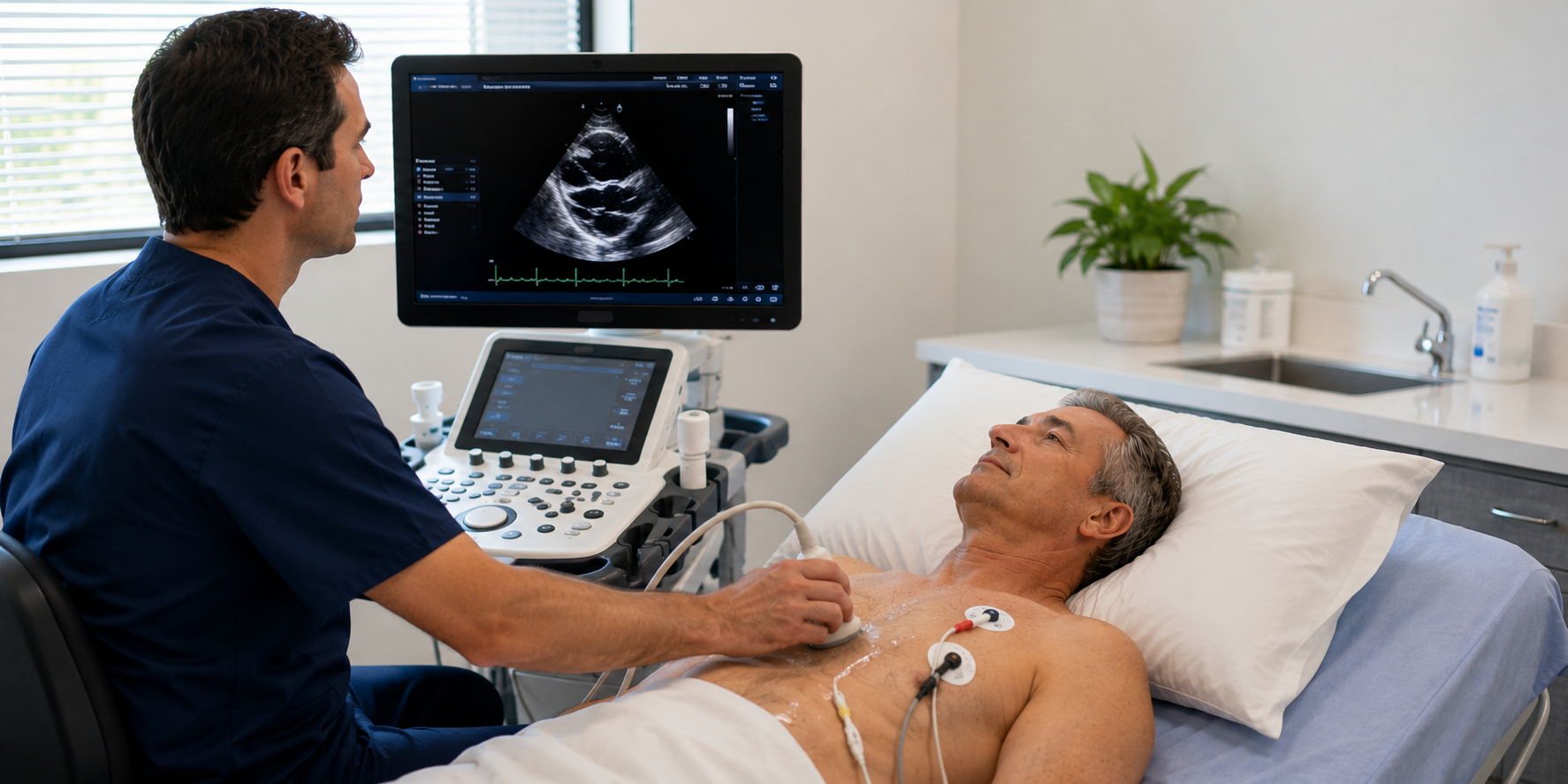
An echocardiogram is a commonly used cardiac imaging test that can help healthcare professionals assess the structure and function of the heart. For residents of Springwood, Logan and Brisbane’s Southside, having access to local cardiac services can make it easier to attend recommended investigations and follow-up appointments.
If you have been searching for a bulk billed echocardiogram Springwood, bulk billed echocardiogram near me, or a heart ultrasound near me, understanding what an echocardiogram involves and when it may be recommended can help you prepare for your appointment.
At Springwood Cardiology and Specialist Centre, echocardiograms are one of the cardiac diagnostic services available at the Springwood location. The practice also provides cardiac consultations, stress echocardiograms, Holter monitoring, blood pressure monitoring, hypertension screening and ECG services.
What Is an Echocardiogram?
An echocardiogram, commonly called an echo or heart ultrasound, is an imaging examination that uses ultrasound waves to create images of the heart.
The examination can provide information about the heart’s chambers, valves, muscle and pumping function. It can also allow assessment of blood flow through the heart.
Because an echocardiogram uses ultrasound rather than ionising radiation, it is a non-invasive imaging test commonly used in cardiac assessment.
Depending on the clinical reason for the examination, an echocardiogram may help a healthcare professional assess conditions affecting the heart valves, heart muscle or overall cardiac function.
Why Might Your Doctor Recommend an Echocardiogram?
An echocardiogram may be recommended for different clinical reasons. Your GP or cardiologist will determine whether the test is appropriate based on your symptoms, medical history, examination findings and other relevant information.
An echocardiogram may be considered when assessing symptoms or findings such as:
- Shortness of breath
- Chest discomfort
- Fatigue
- Heart murmurs
- Swelling
- Changes in heart rhythm
- A known or suspected heart condition
- Abnormal findings from another cardiac examination
It can also be used when monitoring an existing cardiovascular condition.
An echocardiogram should not be viewed as a test that everyone needs routinely. The decision to perform cardiac imaging should be based on individual clinical circumstances and appropriate medical assessment.
What Can a Heart Ultrasound Show?
When you search for a heart ultrasound near me, you may be wondering what information the examination can provide.
An echocardiogram can help assess several aspects of the heart, including:
Heart chambers
The images can provide information about the size and structure of the heart chambers.
Heart muscle function
An echocardiogram can help assess how effectively the heart muscle is moving and pumping.
Heart valves
The examination can provide information about the appearance and movement of the heart valves and blood flow through them.
Overall cardiac structure
The test can provide detailed images that help healthcare professionals assess aspects of the heart’s anatomy.
Springwood Cardiology states that its echocardiography services use advanced imaging technology, including 2D and 4D visualisation and quantitative measurements.
What to Expect During an Echocardiogram in Springwood
If your GP or cardiologist has referred you for an echocardiogram, you may be wondering what happens during the appointment.
A standard echocardiogram is generally performed while you are lying on an examination bed. A sonographer uses an ultrasound transducer against the chest to obtain different views of the heart.
Ultrasound gel is applied to the skin to help transmit the sound waves and produce clear images.
You may be asked to change position during the examination or briefly hold your breath while particular images are captured.
The sonographer collects the required images, which are subsequently assessed and reported by an appropriately qualified medical professional.
The duration of an echocardiogram can vary depending on the type of examination and the information required.
Is an Echocardiogram Painful?
A standard echocardiogram is a non-invasive examination. The ultrasound transducer is placed against the chest, and some pressure may be applied to obtain suitable images.
Most people can return to their usual activities after a standard echocardiogram, unless their healthcare professional provides different instructions.
If you have concerns about the procedure, you can ask the sonographer or healthcare team what to expect before the examination begins.
Bulk Billing and Medicare for Echocardiograms
One of the common searches from local patients is bulk billed echocardiogram near me.
Bulk billing refers to a Medicare billing arrangement where the applicable Medicare benefit is accepted as full payment for an eligible service, subject to Medicare requirements and the provider’s billing policy.
Springwood Cardiology states that bulk billing is available, including options for eligible patients.
However, patients should confirm their eligibility and the billing arrangements for their specific appointment before attending. Medicare requirements, referral requirements and the type of investigation can affect whether a service is bulk billed.
A valid referral may be required for an echocardiogram. If you have been referred by your GP, take the relevant referral documentation with you or confirm with the practice whether it has been received electronically.
Finding a Bulk Billed Echo Near Me in Springwood
For people living in Springwood and surrounding suburbs, local access can be particularly convenient when cardiac investigations or follow-up appointments are required.
When searching for bulk billed echo near me, consider checking:
- Whether the provider offers the type of echocardiogram you have been referred for
- Whether you have the appropriate referral
- Whether you meet the relevant Medicare eligibility requirements
- Whether bulk billing applies to your particular service
- Where the examination is performed
- How the results will be communicated to your referring doctor
Springwood Cardiology & Specialist Centre is located at 52 Cinderella Drive, Springwood QLD 4127 and provides echocardiography and other cardiac services.
Echocardiogram Springwood for Local Communities
Springwood is conveniently positioned for patients from Brisbane’s Southside and surrounding Logan communities.
People searching for Echocardiogram Springwood, Echocardiogram Logan or Echocardiogram near me may be looking for a local service following a GP referral.
Having cardiac diagnostic services available locally may make it easier for patients to attend appointments, particularly when ongoing monitoring is recommended.
Springwood Cardiology also operates a cardiac service in Yarrabilba, providing echocardiography and other cardiac investigations for patients in the surrounding region.
Echocardiogram vs Stress Echocardiogram
A standard echocardiogram and a stress echocardiogram are different examinations.
A standard echocardiogram assesses the heart using ultrasound while you are generally at rest.
A stress echocardiogram combines echocardiographic imaging with exercise or another method of increasing the workload of the heart. It can provide information about how the heart functions under stress and may be used when investigating certain cardiac concerns.
Springwood Cardiology offers both standard echocardiograms and exercise stress echocardiograms.
Your doctor or cardiologist will determine which investigation is appropriate for your circumstances.
How to Prepare for Your Echocardiogram
Preparation requirements depend on the type of cardiac examination you are having.
For a standard echocardiogram, extensive preparation may not be necessary. However, always follow the instructions provided by your healthcare provider.
Before your appointment, it can be useful to:
- Confirm your appointment time
- Check that your referral has been provided
- Bring your Medicare details where applicable
- Provide relevant medical information if requested
- Ask whether any specific preparation is required
- Confirm the applicable billing arrangements
Do not stop or change prescribed medication unless your doctor specifically advises you to do so.
When Should You Speak With Your Doctor?
If you have ongoing symptoms or concerns about your heart, speak with your GP or appropriate healthcare professional.
Symptoms such as chest pain, significant breathlessness, fainting or severe or rapidly worsening symptoms require prompt medical assessment. An echocardiogram is only one component of cardiac assessment and may not be appropriate for every symptom.
Your doctor can determine whether an echocardiogram, ECG, blood tests, Holter monitoring, stress testing or another investigation is suitable.
Frequently Asked Questions
An echocardiogram uses ultrasound waves to produce images of the heart. A transducer is placed against the chest to capture images of cardiac structures and movement.
Springwood Cardiology states that bulk billing is available, including for eligible patients. Patients should confirm Medicare eligibility and the applicable billing arrangements for their individual service before their appointment.
Referral requirements depend on the circumstances and the service being provided. Speak with your GP or the cardiac practice to confirm what referral is required.
Yes. A heart ultrasound is a commonly used term for an echocardiogram, which uses ultrasound technology to create images of the heart.
Patients in Springwood and surrounding communities can speak with their GP about a suitable cardiac imaging provider. Springwood Cardiology & Specialist Centre provides echocardiograms at its Springwood location.
Supporting Your Heart Health
An echocardiogram can provide valuable information about the structure and function of the heart when it is clinically indicated. For residents searching for Bulk Billed Echocardiogram Springwood, Bulk Billed Echocardiogram Near Me, Echocardiogram Springwood, Echocardiogram Near Me, Bulk Billed Echo Near Me, Echocardiogram Logan or Heart Ultrasound Near Me, understanding the examination and billing process can make the experience easier.
If your GP or cardiologist has recommended an echocardiogram, follow the referral instructions and contact the cardiac practice to confirm appointment requirements, Medicare eligibility and applicable billing arrangements.